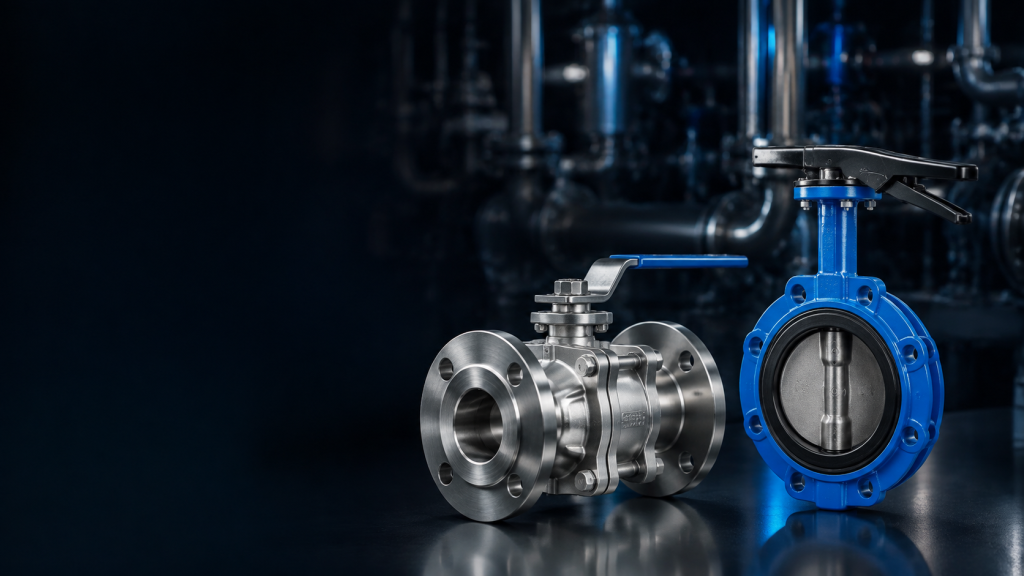
Ball valves and butterfly valves are both popular quarter-turn valves, but they solve different problems. The better choice depends on the medium, pipe size, shut-off requirement, pressure and budget – not on which valve is more familiar.
How each valve works
A ball valve uses a drilled ball that rotates 90 degrees. When the bore aligns with the pipe, flow passes through; when it turns perpendicular, flow stops. A butterfly valve uses a disc that rotates inside the flow path. In the open position the disc remains in the line, creating some flow obstruction.
At-a-glance comparison
| Factor | Ball valve | Butterfly valve |
|---|---|---|
| Typical strength | Tight isolation and compact automation | Light, economical large-diameter isolation |
| Flow path | Full-bore versions have low restriction | Disc stays in the flow path |
| Large sizes | Can become heavy and costly | Often the more practical choice |
| Shut-off | Excellent when seat and service are matched | Good to excellent, depending on design and seat |
| Throttling | V-port designs are preferable for control | Can provide limited throttling in suitable service |
| Installation | Flanged, threaded, welded or trunnion designs | Wafer, lug and flanged styles are common |
When a ball valve is usually the better fit
Choose a ball valve when you need dependable on/off isolation, low pressure drop or a compact automated package. Full-port ball valves are widely used where pigging, flow capacity or minimal restriction is important. Trunnion-mounted designs can be appropriate for higher pressure or larger bore duties where operating torque must be managed.
Seat selection is essential. PTFE and other soft seats can provide tight sealing in many chemical and utility services, but temperature, pressure and media compatibility must be checked. Metal-seated ball valves may be considered for higher temperature or abrasive service.
When a butterfly valve is usually the better fit
Butterfly valves are often attractive for water treatment, HVAC, cooling water, fire protection and other large-bore applications. Their short face-to-face dimension and lower weight can simplify installation, especially on larger pipelines.
For demanding services, consider the design rather than treating all butterfly valves as equivalent. Concentric resilient-seated valves are common for utility duties; double-offset and triple-offset designs may be used where pressure, temperature, tightness or metal-seat performance is more demanding.
Five questions to decide quickly
- Do you need full bore or very low pressure loss? Consider a ball valve.
- Is the line large diameter and cost-sensitive? Start by evaluating a butterfly valve.
- Is the valve primarily for throttling? Specify a control-valve solution or a design expressly rated for control.
- Does the medium contain solids or create abrasion? Confirm disc/seat or ball/seat suitability with the supplier.
- Will the valve be automated? Provide torque, cycle rate, fail position and control requirements.
Avoid these common mistakes
Do not assume a soft-seated valve is appropriate for every temperature. Do not select a wafer butterfly valve without checking flange compatibility and installation requirements. And do not compare quotations only by unit price: pressure class, body material, seat, test requirements, actuator brand and documentation can materially change the delivered value.
Request a matched quotation
Share your medium, line size, pressure class, temperature, connection type and automation needs. StarSprink can source ball and butterfly valve options from verified manufacturers and arrange inspection before export.
Need a matched quotation? Browse industrial products or send StarSprink your inquiry.
FAQ
Is a ball valve always better for shut-off?
Not always. Both valve families can provide effective isolation when the design, seat and service conditions are correctly matched. The operating envelope is more important than the valve name.
Which is less expensive in large sizes?
Butterfly valves are often more economical and lighter in larger diameters, but the final comparison must use the same pressure rating, materials, connection and inspection scope.