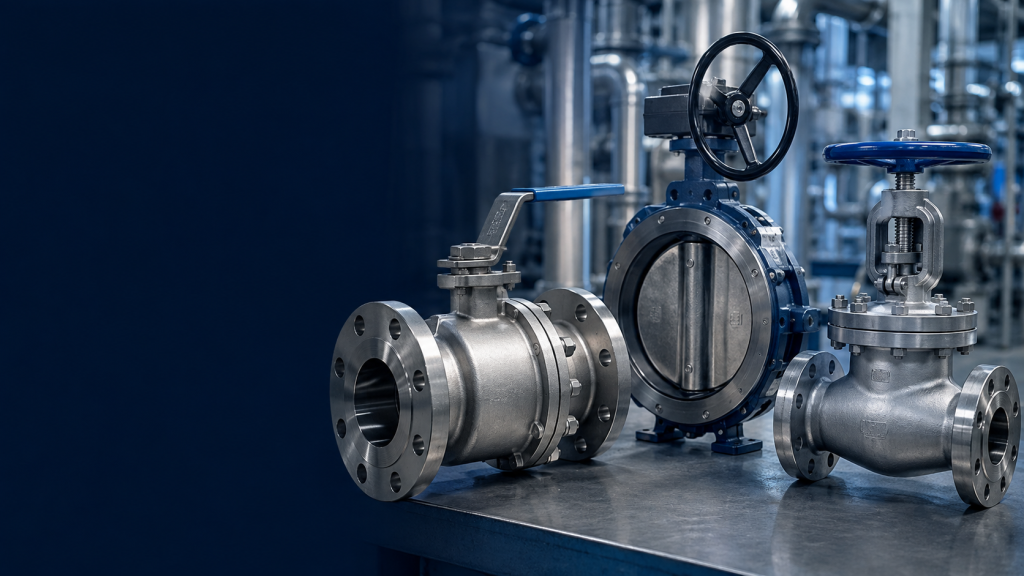
The right industrial valve is not simply the one with the correct size. It must control the intended function, withstand the real operating conditions and connect correctly to the rest of the piping system. A valve that looks suitable on a data sheet can still cause leakage, poor control, premature wear or costly downtime if the service conditions were not fully defined.
Use the following sequence before you ask suppliers to quote.
1. Start with the valve's job
First define what the valve must do in the line.
| Required duty | Common valve families | Typical reason |
|---|---|---|
| Full shut-off / isolation | Ball, gate, butterfly | Stops or starts flow |
| Flow regulation | Globe, control valve, V-port ball | Provides controllable throttling |
| Prevent reverse flow | Swing, dual-plate, lift or axial check | Protects pumps and piping |
| Overpressure protection | Safety or relief valve | Opens at a set pressure |
| Fast automated on/off | Actuated ball or butterfly valve | Fits remote control and frequent cycles |
Do not use an isolation valve as a control valve unless its design is specifically suited to throttling. For example, a standard gate valve is usually intended for fully open or fully closed service; operating it half-open can damage the seats and wedge.
2. Define the process medium and operating envelope
The quotation should state the medium, maximum and normal pressure, temperature range, flow rate, solids content and any corrosion or contamination concern. "Water valve" is not enough information: potable water, hot water, seawater, wastewater and abrasive slurry can require very different bodies, seats and coatings.
Pay particular attention to these questions:
- Is the medium clean, viscous, corrosive, abrasive, flammable or toxic?
- Is the stated pressure the normal pressure, the design pressure or a possible surge pressure?
- Is the temperature steady, or are there startup, steam-out or cleaning cycles?
- Could vacuum, cavitation, flashing or water hammer occur?
3. Match the material and sealing system
Material choice is an application decision, not only a cost decision. Carbon steel may be appropriate for many oil, gas and utility duties; ductile iron is common in water networks; stainless steel is often chosen for corrosion resistance; and lined or special-alloy valves may be required for aggressive chemical service.
The seat, packing and gasket materials matter just as much as the body. Soft seats can offer tight shut-off at moderate temperatures, while metal seats may be needed for elevated temperature, abrasive media or fire-safe requirements. Ask the supplier to confirm compatibility with your exact process medium and temperature range.
4. Confirm the pressure rating, end connection and size
Specify the nominal size and pressure designation used by the project: for example DN/PN or NPS/Class. These systems are not interchangeable by name alone. The valve's end connection must match the mating piping and flange standard: flanged, wafer, lug, threaded, socket-weld, butt-weld, tri-clamp or another project requirement.
Also check face-to-face dimensions, flange drilling, bore requirements and installation space. A technically suitable valve that does not match the available layout creates unnecessary field work.
5. Decide how it will be operated
Manual levers and handwheels are appropriate for many local operations. Gearboxes can reduce operating torque on larger valves. Pneumatic, electric and hydraulic actuators suit remote operation, frequent cycling and automated process control.
For an actuated valve, include failure position, available air supply or electrical power, control signal, enclosure requirement, manual override, cycle frequency and any position-feedback requirement in the RFQ.
A practical pre-RFQ checklist
Before you submit an inquiry, collect:
- Valve function and type preference, if known
- Medium and concentration
- Size, design pressure and design temperature
- End connection and governing standard
- Body, trim and seat material requirements
- Manual or automated operation
- Quantity, delivery location and documentation needs
Need help narrowing the options?
Send StarSprink your line list, valve schedule, drawing or current product specification. Our sourcing team can compare suitable options, confirm supplier capability and arrange inspection documentation before shipment.
Need help narrowing the options? Browse industrial products or send StarSprink your inquiry.
FAQ
What information has the greatest impact on valve selection?
The medium, pressure, temperature, valve duty, connection standard and control method are the essentials. A P&ID, line list or existing valve tag makes a supplier's recommendation much more reliable.
Can I choose a valve based only on pipe size?
No. Pipe size establishes the connection size, but valve type, pressure rating, material and seat must be selected for the process conditions.